

Written by Dr. Akbar Zaib, PhD in Neurosciences
Learning how caregivers can help track Parkinson’s symptoms can make daily changes easier to remember and explain during healthcare appointments — while protecting the person’s privacy, dignity and independence.

Parkinson’s symptoms can change throughout the day, and these changes may be difficult to remember clearly during a healthcare appointment. A person may recall having a difficult week but not remember exactly when a symptom occurred, how long it lasted or which daily activities were affected.
Caregivers are often in a useful position to notice changes in movement, communication, sleep, mood and everyday independence. They may observe freezing while turning, greater difficulty standing from a chair, softer speech or increasing help needed with dressing and eating. They can also record symptoms described by the person, including pain, fatigue, anxiety or dizziness.
However, caregiver tracking should be a shared process. The person with Parkinson’s should remain involved in deciding what is recorded, how often observations are made and who can see the information. Tracking should provide support without making someone feel constantly watched, judged or deprived of control.
This guide explains how caregivers can help track Parkinson’s symptoms respectfully, record useful observations and prepare clearer information for healthcare appointments. Symptom records can support conversations with qualified healthcare professionals, but they cannot diagnose a problem or determine treatment.
Why caregiver observations can be helpful
Parkinson’s symptoms may vary from one day — or one part of the day — to another. Some changes may be difficult for the person with Parkinson’s to notice, remember or describe clearly. A caregiver can help preserve practical details while they are still fresh.
Caregiver observations may help identify:
- Changes in walking, balance, turning or freezing
- Greater difficulty completing everyday activities
- Differences before and after Parkinson’s medication
- Possible ON and OFF periods
- Changes in speech, facial expression or alertness
- Increasing fatigue, daytime sleepiness or disrupted sleep
- Changes in mood, behaviour or thinking
- Gradual changes occurring over several days or weeks
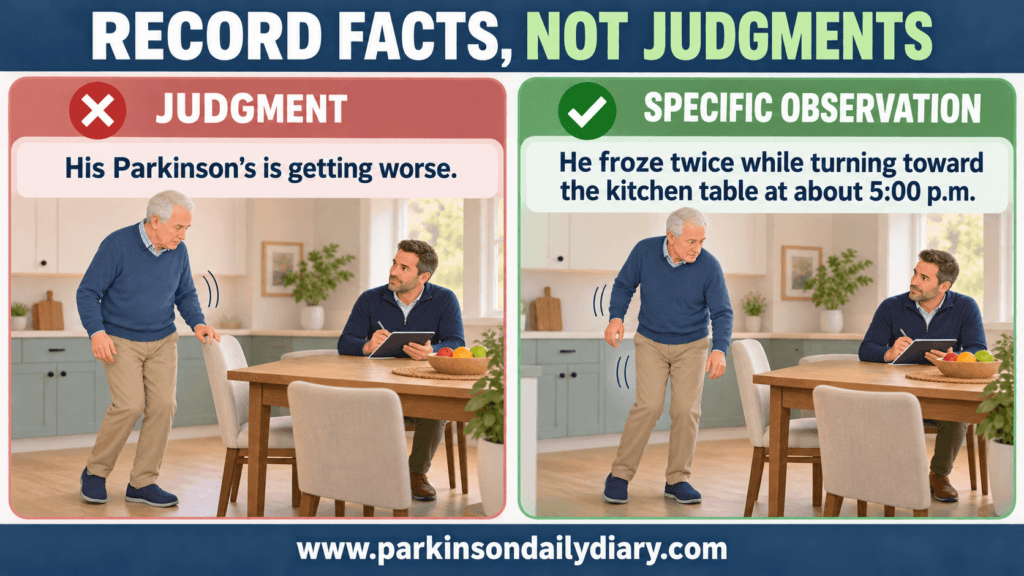
The caregiver’s role is to record what happened, not decide why it happened. For example:
“He froze twice while turning toward the kitchen table at approximately 5:00 p.m.”
This is more useful than:
“His Parkinson’s is getting much worse.”
The first statement describes an observable event. The second is an interpretation that may not reflect the full situation.
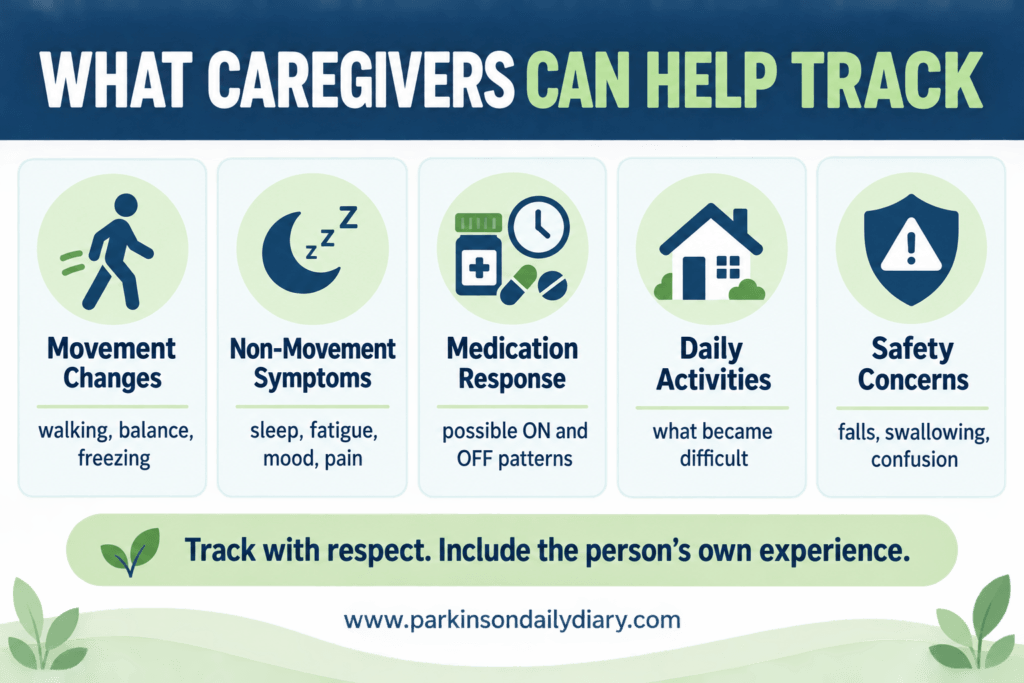
Caregiver observations should also be considered alongside the person’s own experience. A symptom may look mild to someone else but feel painful, frightening or exhausting to the person experiencing it. Both perspectives can provide useful information for the healthcare team.
Agree on what and how to track
Before beginning, talk with the person with Parkinson’s about what kind of help they want. Tracking should be done with their knowledge and permission whenever possible.
Agree on:
- Which symptoms or daily activities should be recorded
- How often an entry should be made
- Whether medication timing should be included
- Which observations the person will record themselves
- What the caregiver will help document
- Who can view or receive the information
- How the record will be used before appointments
Keep the plan manageable. You might focus on two or three current concerns instead of trying to monitor every possible symptom. For example, you may agree to track afternoon freezing, medication response and difficulty getting out of a chair for two weeks.
Preferences may change over time. Review the arrangement occasionally and ask whether the person still feels comfortable with it. They should be able to correct an entry, add their own experience or ask that a personal detail is not shared.
In some situations, cognitive changes may affect decision-making or communication. Follow any existing care plan, legal arrangements and guidance from the healthcare team while continuing to involve the person as much as possible. The aim is to provide support while respecting privacy, dignity and independence.
Observe without making the person feel watched
Symptom tracking should fit naturally into daily life. Repeatedly asking about symptoms or watching every movement can make the person feel uncomfortable, anxious or less independent.
To keep tracking supportive:
- Use one or two brief check-ins at agreed times
- Record important events when they occur
- Avoid commenting on every movement or difficulty
- Ask how the person feels instead of relying only on what you see
- Allow the person to complete activities independently when it is safe
- Avoid discussing symptom scores constantly
- Pause or reduce tracking if it causes stress or disagreement
A simple question may be enough:
“Would you like me to add what happened during your walk to today’s record?”
This approach gives the person a choice. It also avoids treating every difficult moment as something that must automatically be documented.
Caregivers should also avoid comparing one day too closely with another. Parkinson’s symptoms naturally vary, and a single difficult morning does not necessarily mean the condition has permanently worsened.
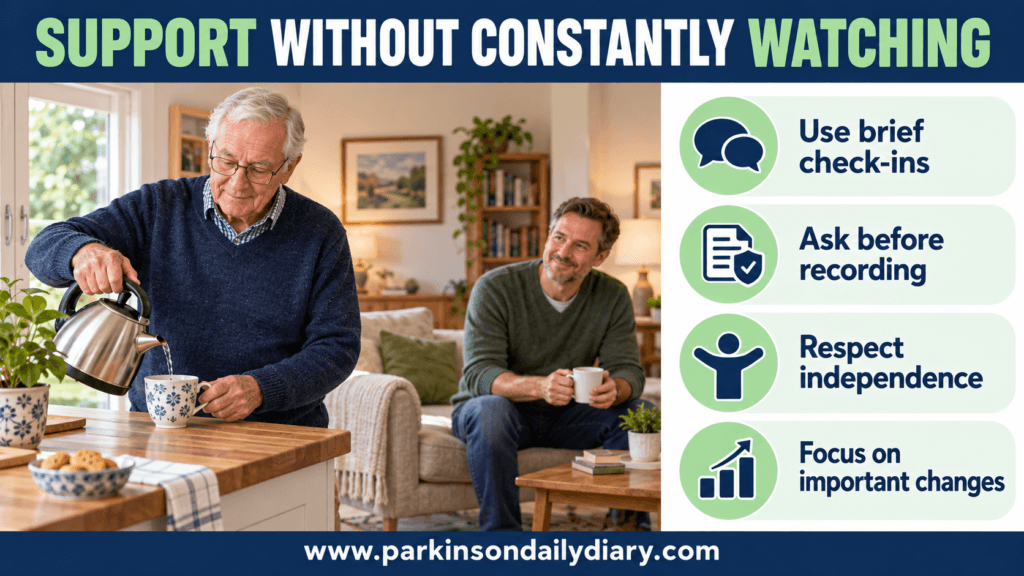
The goal is to preserve useful information without allowing symptom tracking to dominate the relationship. You are still a spouse, relative or friend — not only the person recording symptoms.
Record specific facts, not judgments
Clear, factual observations are usually more useful than broad conclusions. Record what happened, when it occurred, how long it lasted and which activity was affected.
For example, instead of writing:
“He was very confused today.”
Record the specific event:
“At breakfast, he asked three times what day it was within approximately 15 minutes.”
Instead of:
“Her medication was not working.”
Write:
“She took her scheduled dose at 8:00 a.m. At 9:00 a.m., she still needed help standing from the chair and walking to the kitchen.”
A useful entry may include:
- The symptom or change you observed
- The approximate time it started
- How long it continued
- What the person was doing
- Whether help was needed
- What the person said they experienced
- Relevant medication timing
- Any unusual circumstances, such as poor sleep or illness
Avoid labels such as “lazy,” “difficult,” “uncooperative” or “not trying.” Slowness, reduced facial expression, fatigue, speech difficulties and cognitive changes can easily be misunderstood.
Caregiver observations describe what happened; they do not establish its cause. Leave conclusions about diagnosis, disease progression and treatment to qualified healthcare professionals.
Track movement and non-movement symptoms
Caregivers may notice visible movement changes, but Parkinson’s can also cause symptoms that are less obvious. A useful record should include both observable changes and the person’s own description of how they feel.
Movement symptoms may include:
- Tremor, stiffness or slowness
- Freezing while starting, turning or walking through narrow spaces
- Shorter or shuffling steps
- Balance difficulties, near-falls or falls
- Difficulty standing from a chair or getting out of bed
- Changes in handwriting or hand control
- Involuntary movements that may represent dyskinesia
Non-movement symptoms may include:
- Fatigue or daytime sleepiness
- Poor or interrupted sleep
- Pain or discomfort
- Constipation or urinary changes
- Dizziness when standing
- Anxiety, low mood or loss of interest
- Changes in concentration, memory or mental clarity
- Hallucinations or unusual perceptions
- Changes in speech, swallowing or saliva control
Do not try to monitor everything. Focus on new or worsening symptoms, current concerns and changes that affect daily life.
Remember that caregivers cannot directly observe symptoms such as pain, anxiety or dizziness. Ask the person how they feel and record their words as accurately as possible. For example:
“She said she felt light-headed for about one minute after standing from the sofa.”
New, sudden, severe or rapidly worsening symptoms should be discussed with an appropriate healthcare professional rather than simply added to the diary for later review.
Note medication response and ON/OFF patterns
Caregivers may notice that movement, speech, energy or independence changes at certain times in relation to Parkinson’s medication. Recording these observations can provide useful context for the healthcare team.
Consider noting:
- When each scheduled dose was taken
- Whether a dose was late, missed or difficult to swallow
- When the person appeared to experience a benefit
- Whether symptoms returned before the next dose
- Possible nausea, dizziness, sleepiness or other side effects
- Changes in movement, alertness or daily functioning
- Periods that may represent ON or OFF time
ON time generally refers to periods when medication is working and symptoms are better controlled. OFF time describes periods when symptoms return or become more noticeable.
For example:
“He took his medication at 8:00 a.m. By approximately 8:45 a.m., he was walking more easily. Stiffness and shorter steps returned at about 11:30 a.m.”
Not every change occurring near a medication dose is necessarily caused by the medication. Sleep, meals, illness, stress and activity may also affect how the person feels.
Caregivers should record the pattern without changing the dose, timing or frequency themselves. Medication changes should only be made following instructions from an appropriate healthcare professional.
Record the effect on everyday activities
Symptom ratings do not always show how Parkinson’s affects the person’s daily life. Recording which activities became difficult—and what kind of help was needed—can provide more useful context.
Consider changes in the person’s ability to:
- Get out of bed or stand from a chair
- Walk, turn or use stairs safely
- Dress, wash or use the bathroom
- Prepare food, eat or drink
- Take medication correctly
- Write, type or use a phone
- Speak clearly or follow a conversation
- Complete household activities
- Exercise, work or leave the house
- Sleep comfortably or participate socially
For example, instead of writing:
“His stiffness was severe.”
You could record:
“Morning stiffness made it difficult for him to put on his shirt, and he needed help fastening the buttons.”
Also note whether the person:
- Needed more assistance than usual
- Used a walking aid or another support
- Took considerably longer to complete the activity
- Changed or cancelled plans
- Avoided an activity because of symptoms
- Experienced a near-fall or other safety concern
Avoid judging progress only by how much help was required on one occasion. Record the event and look for changes over several days. This can help the healthcare team understand the effect on independence and safety, rather than seeing only a symptom score.
Prepare for healthcare appointments together
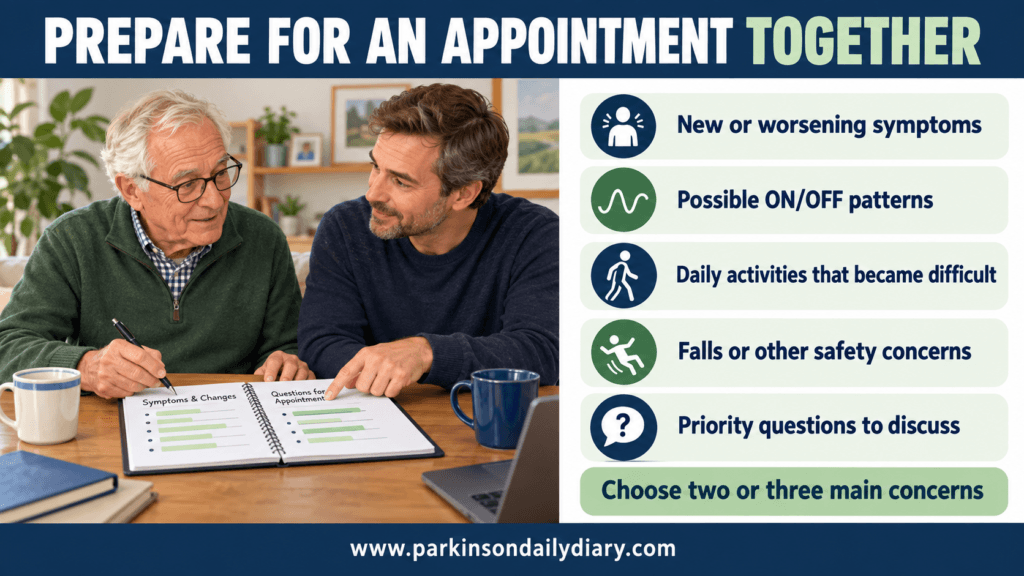
Before an appointment, review the symptom record together and identify the most important points. A short summary is usually easier for the healthcare team to review than a long list of daily entries.
Include:
- New or worsening symptoms
- Changes in frequency, severity or duration
- Possible ON and OFF patterns
- Falls, near-falls, freezing or other safety concerns
- Possible medication side effects
- Difficulties eating, drinking or taking medication
- Activities that now require more help
- Questions from both the person and caregiver
Use specific examples and, where possible, mention the period covered:
“During the past two weeks, he froze while turning on six occasions, mostly between 4:00 and 6:00 p.m.”
Choose two or three priorities for the appointment. Discuss these with the person beforehand so that their concerns remain central to the conversation.
During the appointment, speak with—not only about—the person with Parkinson’s. Allow them time to answer questions and describe their experience. The caregiver can then add observations, explain practical difficulties or mention changes the person may have forgotten.
Before leaving, confirm any agreed next steps. Do not interpret the discussion as permission to change medication unless the healthcare professional provides clear instructions.
Use caregiver access in the Parkinson’s daily diary app
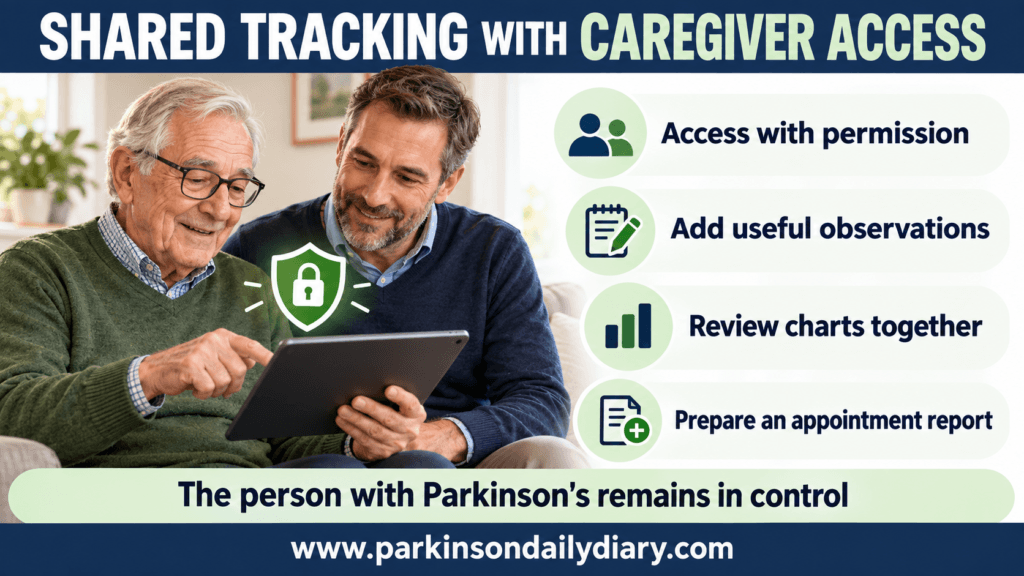
The Parkinson’s Daily Diary App includes caregiver access to make shared symptom tracking easier. With the person’s permission, a caregiver can help maintain an organized record without relying on separate notes or memory.
The app can be used to record:
- Movement and non-movement symptoms
- Symptom severity
- Medication status and response
- ON and OFF periods
- Pain and fatigue
- Changes affecting everyday activities
- Important daily observations
- Questions for the next appointment
Caregivers can add specific details in the notes section. For example:
“Freezing occurred twice while turning in the kitchen at approximately 5:00 p.m. Assistance was needed once.”
Weekly and monthly charts can help both the person and caregiver review changes over time. The app can also generate an organized PDF report for discussion with the healthcare team.
Caregiver access should only be used with clear permission. Agree on who will enter information, what should be recorded and whether the person wants to review entries before they are shared.
The app organizes the information entered by users, but it does not diagnose symptoms, identify their cause or recommend treatment changes. It is a communication and record-keeping tool—not a substitute for professional medical assessment.
10. Know when tracking is not enough
A symptom diary is useful for routine observations, but it should never delay medical advice. Contact the person’s neurologist, Parkinson’s nurse, general practitioner or another appropriate healthcare professional if you notice:
- A new symptom that is persistent or concerning
- A rapid or major worsening of existing symptoms
- Repeated falls or increasing difficulty walking safely
- New confusion, hallucinations or significant behavioural changes
- Severe dizziness, fainting or unusual sleepiness
- Increasing difficulty swallowing food, fluids or medication
- Symptoms preventing the person from eating, drinking or taking medication
- A possible medication side effect
- A sudden change following a medication adjustment
Sudden confusion or a rapid decline should not automatically be considered part of Parkinson’s progression. Infection, dehydration, medication changes and other health problems can cause an abrupt worsening and may require prompt assessment.
If it is safe and practical, record what happened and when it began. However, obtaining appropriate medical help must come first. The Parkinson’s Daily Diary App and other symptom trackers are not monitored by healthcare professionals or emergency services.
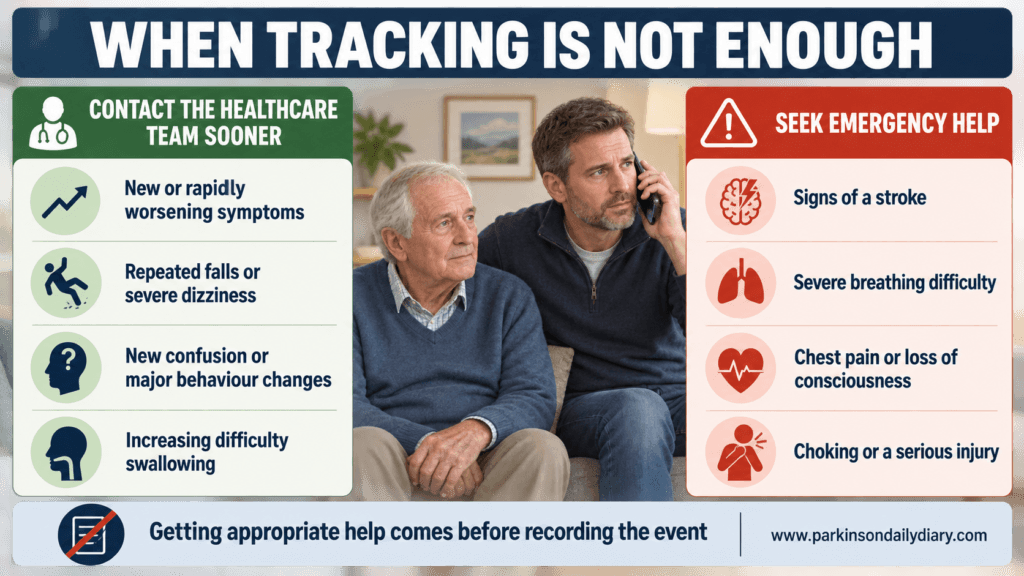
For possible emergencies—such as signs of a stroke, severe breathing difficulty, chest pain, loss of consciousness, choking or a serious injury — contact local emergency services immediately.
Support better tracking without taking away independence
Caregivers can provide valuable information about how Parkinson’s symptoms change between healthcare appointments. The most useful records describe what happened, when it occurred and how it affected everyday activities.
Tracking should always remain respectful and manageable. Agree together on what will be recorded, include the person’s own experience and avoid turning daily life into constant observation. The aim is to support clearer communication—not to diagnose symptoms, judge the person’s abilities or make treatment decisions.
The Parkinson’s Daily Diary App allows a person with Parkinson’s and their caregiver to keep symptom records organized in one place. You can document movement and non-movement symptoms, medication response, ON and OFF periods, pain, fatigue and important daily observations. Weekly and monthly charts and an organized PDF report can help prepare for healthcare appointments.
Start Tracking Together for Free
Always discuss new, worsening or concerning symptoms with an appropriate healthcare professional. Do not change medication or treatment based only on observations recorded in the app.
Important medical disclaimer
This article provides general educational information for people with Parkinson’s and their caregivers. It does not provide medical advice, diagnosis, treatment recommendations or emergency monitoring.
Caregiver observations and information recorded in a symptom tracker should be discussed with a qualified healthcare professional. Do not start, stop, change or reschedule medication or treatment based only on recorded symptoms, caregiver observations or patterns you believe you have noticed.
Seek professional medical advice about new, worsening, severe or concerning symptoms. In a possible medical emergency, contact your local emergency services immediately.