

Knowing what to record in a Parkinson’s symptom diary can feel confusing. You do not need to document every movement or every hour of the day. A useful diary focuses on a small number of details that help you remember meaningful changes and prepare for conversations with your healthcare professional.

Parkinson’s symptoms can vary from person to person and may also change from one day to the next. This can make keeping a diary useful—but also confusing. Should you record every symptom, describe your entire day, or note only the changes that seem important?
A useful Parkinson’s symptom diary does not need to be long or highly detailed. The aim is to create a brief, consistent record that helps you remember your symptoms, medication status, meaningful daily difficulties, and questions for your healthcare professional.
This guide provides a practical checklist of what to include, what you can leave out, and how to keep daily tracking manageable. It also explains how the Parkinson’s Daily Diary App can help you organize these details in one place without turning symptom tracking into a demanding task.
Your main Parkinson’s symptoms
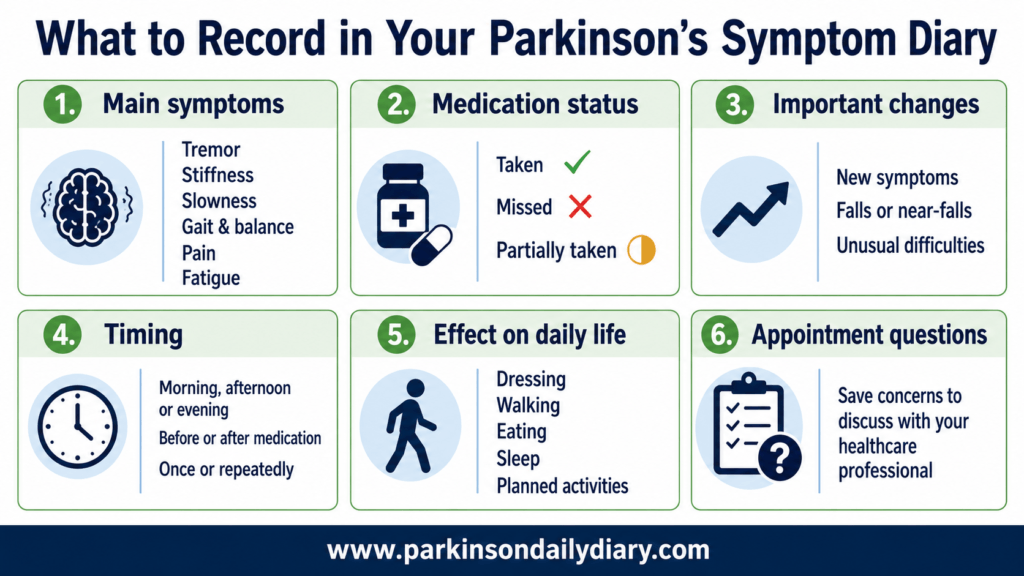
Begin with the symptoms that affect you most. You do not need to give equal attention to every possible Parkinson’s symptom, especially if some are not part of your daily experience.
The Parkinson’s Daily Diary App allows you to record the severity of six symptoms:
- Tremor
- Stiffness
- Slowness of movement
- Gait and balance difficulties
- Pain
- Fatigue
Try to rate these symptoms consistently according to how they felt to you that day. For example, if stiffness made dressing or getting out of a chair noticeably more difficult, your rating may be higher than on a day when it caused little disruption.
The number you choose represents your personal experience. It is not a clinical measurement, diagnosis, or assessment of how advanced your Parkinson’s may be. What matters most is using the scale in a reasonably consistent way so that you can compare your own entries over time.
You may also experience symptoms that are not included among these six categories. If another symptom or change feels important, add a short description in the daily notes section.
The goal is not to capture every sensation. Focus on symptoms that were noticeable, changed from your usual experience, or affected something you wanted or needed to do.
Whether your medication was taken
Medication information can provide helpful context when you review your diary. You do not need to write a detailed medication history every day. In the Parkinson’s Daily Diary App, you can simply record whether your medication was:
- Taken
- Missed
- Partially taken
For example, if you recorded greater stiffness or slowness on a particular day, the medication entry may help you remember whether a dose was missed or only partially taken. However, two events appearing in the same entry does not prove that one caused the other. Symptoms may change for many different reasons.
If something unusual occurred—such as difficulty swallowing a tablet or forgetting a dose—you can add a brief note for context. Do not use the diary to make your own conclusions about whether a medication is working.
Never start, stop, change, or adjust the timing or dose of Parkinson’s medication based solely on diary entries. If you repeatedly miss doses, experience possible side effects, or have concerns about how your medication affects you, discuss the recorded information with your prescribing healthcare professional.
If you need a more detailed record of medication names, doses and timing, you can also use our free Parkinson’s medication-management diary.
Important changes or daily difficulties
Symptom ratings provide a useful overview, but a short note can explain what actually happened during the day. You do not need to describe everything. Add a note when something is new, unusual, noticeably different, or important enough to discuss with your healthcare professional.
Examples might include:
- A new or noticeably changed symptom
- A fall or near-fall
- Difficulty getting out of a chair
- Taking longer than usual to get dressed
- Trouble walking in a particular situation
- A symptom that disturbed your sleep
- Difficulty eating, writing, or completing another activity
- Feeling unusually tired during part of the day
Keep your notes brief and specific. For example:
“Needed help getting out of the chair after lunch.”
This preserves more useful information than simply writing:
“Bad day.”
A specific note records the difficulty, the activity it affected, and approximately when it occurred. You can then review it later without trying to reconstruct the whole day from memory.
The notes section is not intended to replace medical assessment. Its purpose is to preserve meaningful observations that may add context to your symptom ratings and support a clearer conversation at your next appointment.
Timing and patterns that stand out
When something significant happens, noting the approximate time can provide useful context. You do not need to create an hour-by-hour record. Broad descriptions are usually easier to maintain, such as:
- Morning, afternoon, or evening
- Before or after taking medication
- During or after a particular activity
- While getting out of bed or preparing for sleep
- Once during the day or repeatedly
For example, instead of writing only, “Stiffness was worse,” you could note:
“Stiffness was more noticeable this morning while getting dressed.”
If the same difficulty occurs on several days, your entries may help you remember that it happened repeatedly. However, the diary cannot determine whether a meaningful medical pattern exists or explain why the change occurred.
The Parkinson’s Daily Diary App is designed for a short daily check-in, not detailed hourly or ON/OFF monitoring. When timing feels relevant, add it briefly in the daily notes section.
Record only the timing that helps explain your experience. The aim is to preserve useful details without turning your diary into a demanding account of every part of the day.
How symptoms affect your day
A symptom rating tells you how noticeable a symptom felt, but it may not show how it affected your everyday life. Adding a brief description of its practical impact can make the diary more meaningful.
For example, you might record that you:
- Needed help getting dressed
- Took longer than usual to prepare a meal
- Avoided a walk because of balance concerns
- Had difficulty turning in bed
- Could not complete a planned activity
- Needed more rest than usual
- Found writing, eating, or using a phone more difficult
- Required assistance getting up from a chair
Try to describe the activity rather than making a general statement. For example:
“Balance felt unsteady, so I did not take my usual afternoon walk.”
This provides more context than writing only, “Balance was bad.”
You do not need to record every small inconvenience. Focus on changes that affected your independence, safety, comfort, or ability to complete an important activity.
These details may help your healthcare professional understand why a symptom mattered to you. However, diary entries are personal observations and should be considered alongside your medical history and a professional clinical assessment.
You may also find it helpful to review our practical morning-to-night routine for Parkinson’s disease when considering which everyday activities to mention in your diary.
Questions and concerns for your healthcare professional
Questions often arise between appointments but can be difficult to remember when the appointment finally arrives. Recording them as they occur can help you prepare for a more focused conversation with your healthcare professional.
Your questions might include:
- “Why has my morning stiffness become more noticeable?”
- “Could we discuss the balance difficulties I recorded?”
- “What should I do if I miss or only partially take a dose?”
- “Should this new symptom be assessed?”
- “Could we review the difficulties I have had with dressing?”
- “Are there safe ways to manage the fatigue I recorded?”
The Parkinson’s Daily Diary App includes a Notes for Next Appointment feature where you can save questions and concerns separately from your daily entries. Before your visit, review these notes and select the issues that matter most to you.
The diary should help you remember what you want to discuss—not encourage you to diagnose the cause yourself. If a symptom is new, severe, rapidly worsening, or otherwise concerning, contact a healthcare professional promptly rather than saving the question for a routine appointment.
What can you leave out?
A useful Parkinson’s symptom diary does not need to contain every detail of your day. Recording too much can make tracking tiring and difficult to continue.
You can usually leave out:
- A minute-by-minute account of your activities
- Long descriptions when a short, specific note is enough
- Every minor sensation that has no meaningful effect on your day
- The same information repeated when nothing has changed
- Your own diagnosis of what caused a symptom
- Conclusions that a medication or activity caused a particular change
- Details unrelated to your symptoms, medication, daily difficulties, or appointment questions
For example, you do not need to describe your entire morning to explain a mobility difficulty. A note such as, “Needed help getting out of bed because of stiffness,” preserves the relevant information clearly.
Some days may require only symptom ratings and medication status, with no additional note. On other days, one short observation may provide useful context.
Record enough to preserve meaningful details, but not so much that the diary becomes difficult to maintain. A brief record that you can complete consistently is generally more practical than a detailed journal you soon stop using.
Example of a useful Parkinson’s diary entry
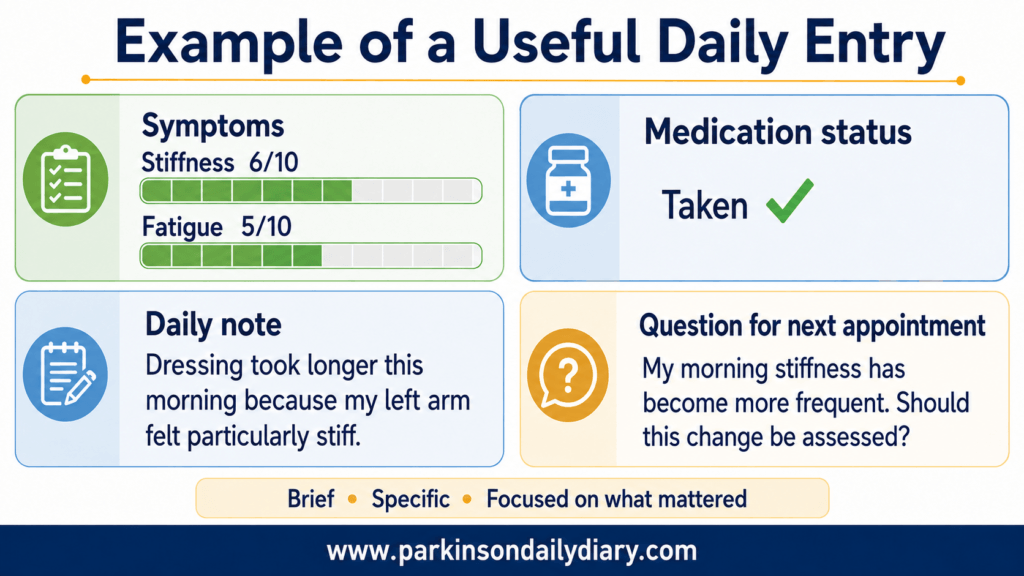
A helpful entry can be brief while still preserving the most important information. For example:
Symptoms: Stiffness 6/10; fatigue 5/10
Medication status: Taken
Daily note: Dressing took longer this morning because my left arm felt particularly stiff.
Question for next appointment: My morning stiffness has become more frequent. Should this change be assessed?
This entry works because it records the symptoms and their perceived severity, confirms the medication status, and explains how the stiffness affected a daily activity. It also preserves a specific question for the next appointment.
You do not need to write this much every day. If nothing unusual happened, recording your symptom ratings and medication status may be enough. When a change does stand out, one clear sentence can add helpful context.
The objective is not to produce a formal medical record. It is to create a personal summary that helps you remember what happened and communicate your observations more clearly to your healthcare professional.
Record these details in one place
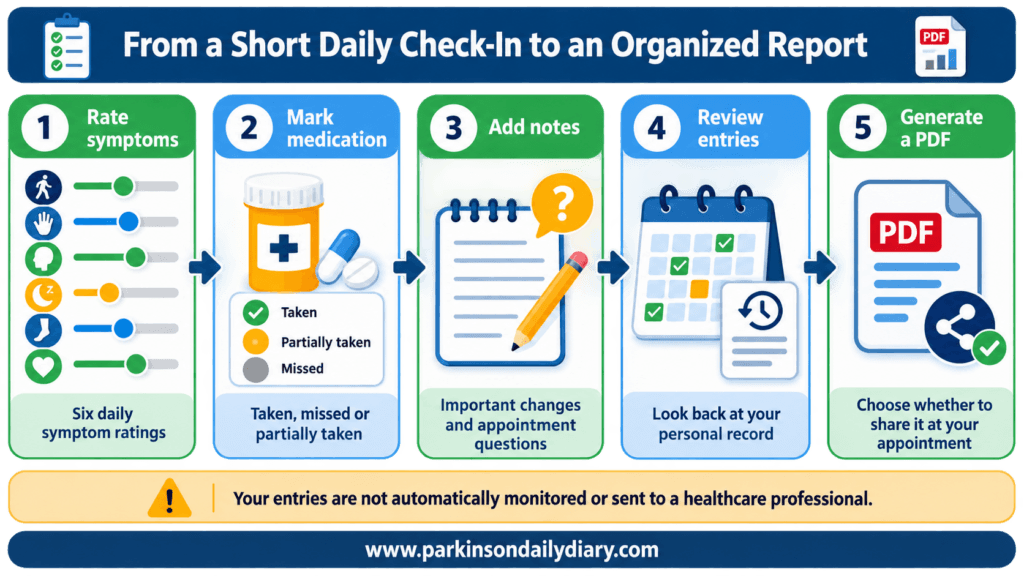
Using separate notebooks, medication lists, and reminder notes can make it difficult to find the information you need. The Parkinson’s Daily Diary App keeps your main daily observations together in one place.
You can use the app on a mobile phone or laptop to:
- Rate six symptoms: Record tremor, stiffness, slowness of movement, gait and balance difficulties, pain, and fatigue.
- Record medication status: Mark your medication as taken, missed, or partially taken.
- Add an optional daily note: Preserve a meaningful change, difficulty, or observation without writing a lengthy journal entry.
- Save appointment questions: Use Notes for Next Appointment to record concerns when they arise.
- Review previous entries: Look back at what you recorded instead of relying entirely on memory.
- Generate a PDF report: Organize your recorded information into a report that you can review and choose to share with your healthcare professional.
The app does not interpret your entries, identify medical patterns, or automatically send your information to a doctor. It is a personal tracking and organizational tool designed to make regular recording more manageable.
Some changes should not wait for a diary review
The diary can help you preserve useful information, but it does not monitor your entries or alert a healthcare professional when something changes. Your records are not automatically reviewed by a doctor, clinic, or emergency service.
Contact a qualified healthcare professional promptly if you experience a symptom that is new, severe, rapidly worsening, or otherwise concerning. Do not wait for your next routine appointment simply because you have recorded the change in the app.
Seek timely professional advice if a problem substantially affects essential activities such as walking, swallowing, eating, taking medication, or staying safe. If you believe that you or someone else may be experiencing a medical emergency, contact your local emergency services immediately.
Record relevant details when it is safe to do so, but always prioritize appropriate medical care over completing a diary entry.
Start with a short daily check-in
Knowing what to record in a Parkinson’s symptom diary does not mean documenting every part of your day. A useful entry can include your main symptoms, medication status, one meaningful change or daily difficulty, and any question you want to raise with your healthcare professional.
Keep your entries brief and focus on details that help you remember what happened. Consistent check-ins can gradually create a more organized record without making symptom tracking feel overwhelming.
The Parkinson’s Daily Diary App gives you one place to record this information, review previous entries, and generate a PDF report that you may choose to share at an appointment.
The app can be used on a mobile phone or laptop.
Important medical disclaimer
Parkinson’s Daily Diary App is a personal tracking and organizational tool. It does not provide medical advice, diagnosis, treatment recommendations, emergency monitoring, or automatic review by a healthcare professional.
Information recorded in the app should be discussed with a qualified healthcare professional. Do not start, stop, or change any medication or treatment based solely on diary entries or information provided through the app.
Always seek professional medical advice about new, worsening, severe, or concerning symptoms. In a medical emergency, contact your local emergency services immediately.