

A Parkinson’s neurology appointment may be one of the few opportunities you have to discuss several weeks or months of changes. Learning how to prepare for a Parkinson’s neurologist appointment can help you remember important concerns, ask clearer questions, and use the limited appointment time more effectively.

A neurologist needs to understand what has changed since your previous visit, how those changes affect daily life, and whether your current treatment remains manageable. However, remembering every symptom, medication concern, fall, or question during a short appointment can be difficult.
Preparing in advance does not require a complicated medical file. A brief symptom record, an accurate medication list, and a few prioritized questions can help make the conversation clearer and more focused. A caregiver or family member may also contribute useful observations when appropriate.
This guide explains what to review, what to bring, and what to ask before a Parkinson’s neurologist appointment. It also covers how to use the appointment effectively and record the agreed next steps afterward.
Start preparing before the day of your appointment
Try to begin preparing several days before your appointment rather than collecting everything the night before. This gives you time to review recent experiences and decide which concerns matter most.
Start by checking the appointment date, time, location, and whether the consultation will be in person, by telephone, or online. Confirm whether you need to complete any forms or arrange tests beforehand.
Review what has happened since your previous visit. If a caregiver or family member regularly supports you, ask whether they have noticed any meaningful changes that you may have overlooked.
Gradually gather your medication information, symptom records, appointment questions, and relevant medical documents in one place. You do not need to create a lengthy medical history. The aim is to arrive with a short, organized summary that helps you explain your main concerns without relying entirely on memory.
1. Identify what has changed
Before your appointment, think about what has changed since your last visit. Focus on symptoms or difficulties that are new, becoming more frequent, noticeably worse, or affecting your daily life differently.
These may include changes in:
- Tremor, stiffness, or slowness of movement
- Walking, balance, freezing, falls, or near-falls
- Pain, fatigue, sleep, or energy
- Speech, swallowing, or drooling
- Mood, anxiety, memory, or thinking
- Dressing, eating, writing, driving, working, or other daily activities
Specific examples can be more informative than general descriptions. Instead of saying, “My walking is worse,” you might explain, “I have started freezing near doorways several times each week,” or “I now need help getting up from a chair in the evening.”
You may have several concerns, but appointment time can be limited. Choose the two or three changes that affect your safety, independence, comfort, or quality of life most. Write these at the top of your list so they are discussed first.
Do not wait for a routine appointment if a change is severe, rapidly worsening, or otherwise concerning. Contact an appropriate healthcare professional promptly.
2. Review your medications
Bring an up-to-date list of everything you take, including Parkinson’s medications, medicines for other conditions, over-the-counter products, vitamins, and supplements.
For each item, record:
- The medication name
- Strength and dose
- The usual time you take it
- How often you take it
- Any recently prescribed, stopped, or changed medication
Also note practical concerns such as missed or partially taken doses, difficulty swallowing tablets, possible side effects, or medication that seems to wear off before the next scheduled dose. If timing is important to your concern, record approximately when the difficulty occurs and how it affects you.
Whenever possible, bring the original packaging or an accurate printed medication list. Do not rely on remembering medication names and doses during the appointment.
The Parkinson’s Daily Diary App can show whether medication was marked as taken, missed, or partially taken on previous days. However, it does not replace a complete medication list containing names, doses, and schedules.
Do not change, delay, stop, or combine doses in preparation for the appointment unless a qualified healthcare professional has specifically instructed you to do so.
3. Bring a record of your recent symptoms
It can be difficult to summarize several weeks or months of changing symptoms from memory. A short daily record can help you bring more specific information to your neurologist.
A useful diary does not need to document every moment of the day. Our practical guide explains what to record in a Parkinson’s symptom diary and what can usually be left out.
Your record might include:
- The symptoms that affected you most
- When an important change first appeared
- Whether a problem happened once or repeatedly
- Falls, near-falls, swallowing difficulties, or other safety concerns
- How symptoms affected walking, dressing, eating, sleeping, or other activities
- Whether medication was taken, missed, or partially taken
- Brief notes about particularly difficult or unusual days
The Parkinson’s Daily Diary App allows you to record tremor, stiffness, slowness, gait and balance difficulties, pain, fatigue, medication status, and important notes. You can review previous entries and generate an organized PDF report to bring to your appointment.
Focus on information that supports your main concerns rather than presenting every entry in detail. A concise overview may be easier to discuss during a limited appointment.
The app does not diagnose changes, identify their cause, or automatically send information to your neurologist. You decide whether to share the PDF, and your healthcare professional interprets your observations alongside your medical history and clinical assessment.
4. Write down the questions you want to ask
Questions can easily be forgotten once an appointment begins, especially when several symptoms or treatment concerns need attention. Write them down as they arise rather than trying to remember everything on the day.
Possible questions include:
- Could this new or worsening symptom be related to Parkinson’s disease?
- Should my current medication schedule be reviewed?
- What should I do if I miss or only partially take a dose?
- Could any of my symptoms be medication side effects?
- Would physiotherapy, occupational therapy, speech and language therapy, or another referral be appropriate?
- Which changes should I report before my next routine appointment?
- When should my next review take place?
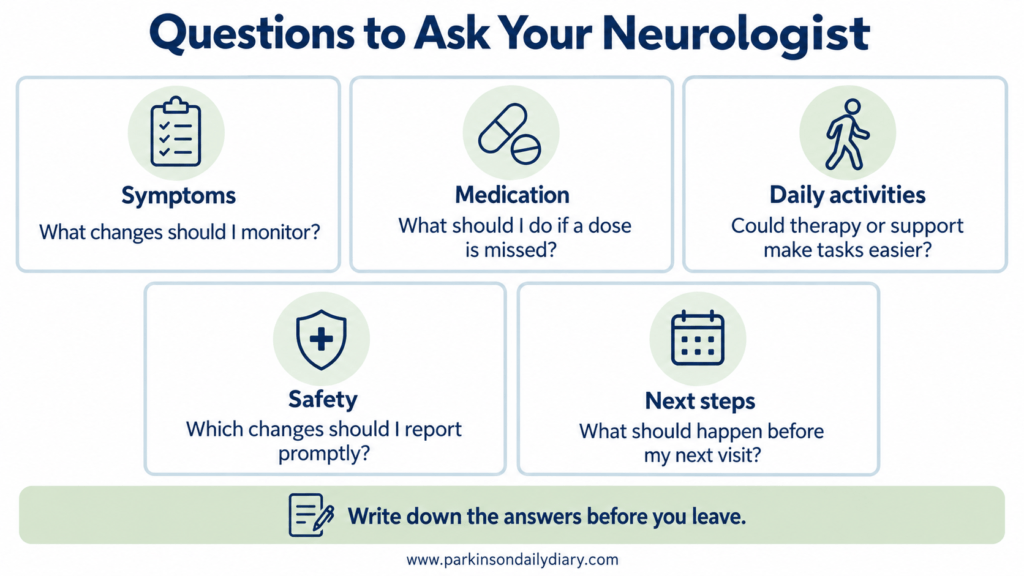
A long list may be difficult to cover. Mark your three most important questions and place them at the top. Prioritize concerns involving safety, independence, significant discomfort, or a clear change in daily functioning.
The Parkinson’s Daily Diary App includes Notes for Next Appointment, allowing you to save questions when they occur. Review these notes before your visit and combine similar concerns.
During the appointment, ask for clarification if an answer is unclear. Before moving on, briefly repeat your understanding to confirm that you have interpreted the advice correctly.
5. Consider bringing a care partner
A spouse, relative, friend, or caregiver may provide useful support during a neurology appointment. They may remember changes you have overlooked, help explain what happens at home, take notes, or remind you about a question you intended to ask.
Before the appointment, agree on the main concerns and decide how the care partner will help. This can prevent interruptions or confusion during the consultation. They might listen and take notes while you speak, then add observations when invited.
The person with Parkinson’s disease should remain at the centre of the conversation whenever possible. A care partner’s role is to support their account, not speak over them or answer every question on their behalf.
Some concerns may also need to be discussed privately. Decide beforehand whether there is anything you would prefer to raise alone with the neurologist.
If someone cannot attend in person, ask the clinic whether they may join briefly by telephone or video. Clinic policies and patient-consent requirements may vary.
Your Parkinson’s appointment checklist
Keep everything together in a folder, envelope, or clearly labelled section on your phone. Before leaving for the appointment, check that you have:
- An up-to-date list of all medications, doses, and usual times
- Your recent symptom diary or PDF report
- Your three most important questions
- Notes about new symptoms or changes since the previous visit
- Details of falls, near-falls, swallowing difficulties, or other safety concerns
- Relevant test results, hospital letters, or reports not already held by the clinic
- Contact details for other healthcare professionals involved in your care
- A notebook and pen, or a phone for recording instructions
- Glasses, hearing aids, or communication support if needed
- Details of any medication refills, forms, certificates, or referrals you need to discuss
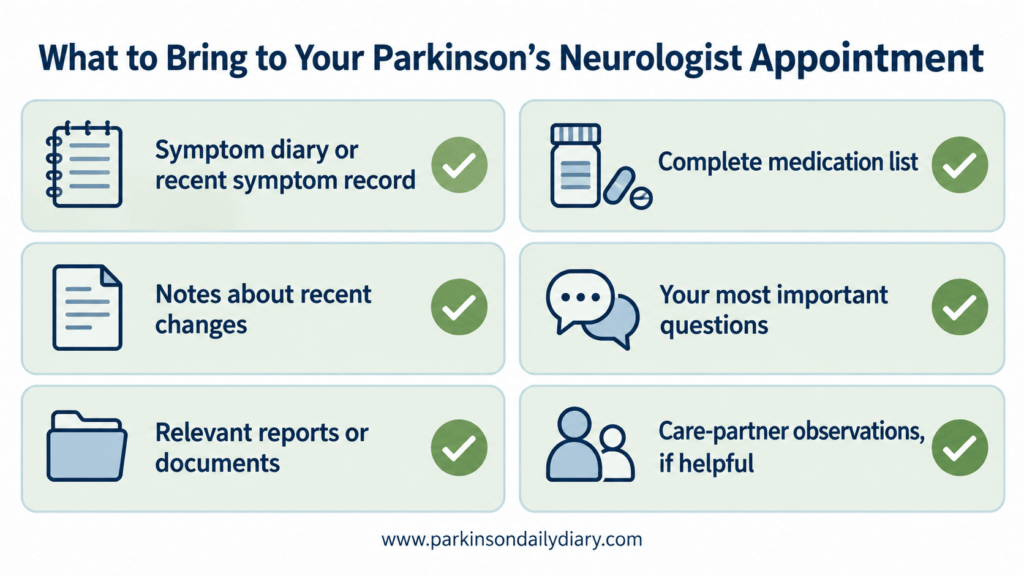
Bring your medication packaging if your written list may be incomplete. If a care partner is attending, give them a copy of your questions or summary.
You may not need every item for every appointment. Focus on information that is current, accurate, and directly connected to the concerns you want the neurologist to address.
How to use the appointment time effectively
Begin by telling the neurologist which two or three concerns matter most to you. Raising the main issue early reduces the chance that it will be missed if time becomes limited.
Describe specific examples rather than using only broad statements. Instead of saying, “My balance is worse,” explain what happened, how often it occurred, and whether it affected your safety or daily activities. Use your symptom record or PDF report to support the conversation, but you do not need to review every entry.
During the appointment:
- Explain how symptoms affect your everyday life
- Mention new symptoms, falls, near-falls, or swallowing concerns
- Ask your prioritized questions
- Inform the neurologist about possible side effects or medication difficulties
- Ask for unfamiliar medical terms to be explained in plain language
- Take notes or ask your care partner to record important instructions
- Ask what you should monitor before the next visit
If medication changes are discussed, confirm the exact dose, timing, and start date. Do not assume that general comments are instructions to change treatment.
Before the discussion moves on, briefly summarize what you understood. This gives the neurologist an opportunity to correct any misunderstanding.
Confirm the plan before you leave
Before the appointment ends, make sure you understand what should happen next. Do not hesitate to ask the neurologist to repeat or simplify an instruction.
Confirm:
- Whether any medication will change
- The exact dose, timing, and date of any change
- Whether tests, referrals, or therapy appointments are needed
- Which symptoms or changes you should continue recording
- Which warning signs require earlier contact
- Who to contact if you have questions
- When the next review is expected
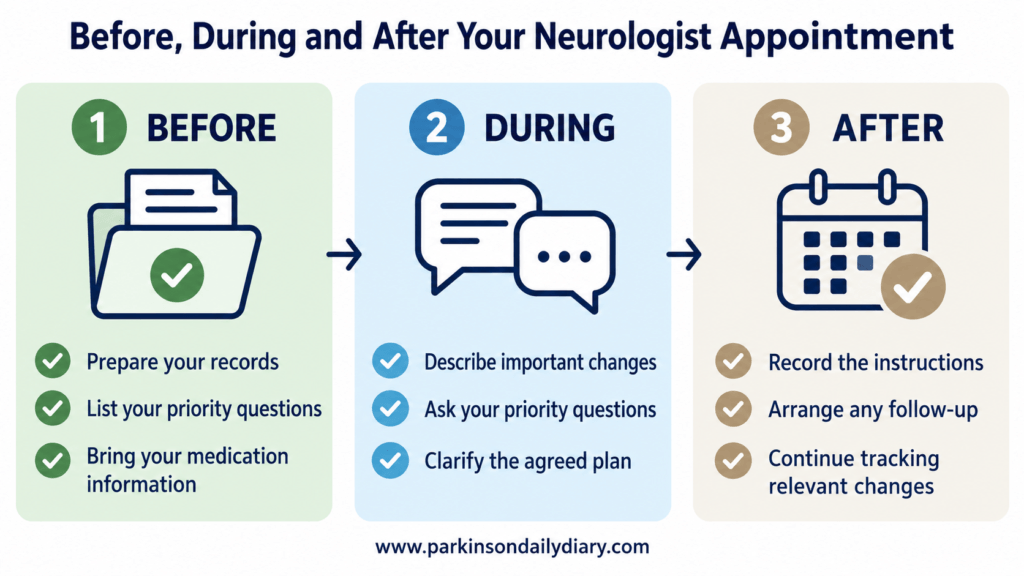
If you receive several instructions, write them down in order. A care partner can help by checking that nothing important has been missed.
Try repeating the plan in your own words—for example, “To confirm, I will begin the new dose on Monday morning and contact the clinic if this problem becomes worse.” This allows the neurologist to correct any misunderstanding.
Before leaving, check whether prescriptions, referral letters, follow-up appointments, or written instructions will be provided immediately or sent later.
Record the next steps while they are fresh
Soon after the appointment, review your notes while the discussion is still fresh. Rewrite any hurried or unclear points so that you and your care partner can understand them later.
Create a short action list that includes:
- Medication changes and their start dates
- Tests, referrals, or therapy appointments
- Symptoms you have been asked to monitor
- Any forms, prescriptions, or information you are waiting to receive
- When and how to arrange the next review
Update your medication list only according to the instructions provided by your healthcare professional. If anything remains unclear or appears different from the written prescription, contact the clinic or pharmacist for clarification rather than guessing.
Share the plan with your caregiver or family member when appropriate and with your permission. Continue recording relevant symptoms and daily difficulties so you have an updated record for the next appointment.
Keep the neurologist’s instructions, appointment summary, and contact information together where you can find them easily.