

Written by Dr. Akbar Zaib, PhD in Neurosciences
A Parkinson’s diary can make daily changes easier to remember and explain. But should you record symptoms on paper or use a digital tracker? In this guide, we compare both methods and help you choose the option that best fits your needs, habits, and comfort with technology.

Parkinson’s symptoms can change throughout the day. Tremor, stiffness, slowness, pain, fatigue, mood, sleep, and medication response may be different in the morning, afternoon, or evening. These changes are not always easy to remember accurately — especially several weeks later during your Parkinson’s appointment.
A Parkinson’s diary provides a regular record of what happens between healthcare visits. It can help you notice when symptoms are better or worse, how long medication appears to work, and whether certain difficulties are becoming more frequent.
The diary does not need to contain every detail of your day. It should focus on information that is useful to you and your healthcare team, such as:
- Your most important symptoms
- Medication timing and response
- ON and OFF periods
- Side effects or unusual changes
- Effects on daily activities
- Questions for your next appointment
Both paper and digital diaries can serve this purpose. The main difference is how information is recorded, organized, reviewed, and shared.
Key takeaway: The most useful Parkinson’s diary is not necessarily the most advanced one—it is the one you can use consistently and bring into conversations with your healthcare team.
Using a paper Parkinson’s diary
A paper diary can be a simple and familiar way to record daily experiences. You can use a notebook, printed symptom tracker, calendar, or prepared diary sheet. No internet connection, account, or electronic device is required.

Paper tracking may be particularly suitable for people who prefer handwriting or do not feel comfortable using digital tools. It also gives you freedom to write longer notes, draw attention to an unusual day, or adapt the page to suit your own needs.
Advantages of a paper diary
- Easy to start without technical setup
- Familiar for people who prefer writing by hand
- Flexible space for personal notes
- No screen, internet connection, or password required
- Can be taken directly to an appointment
However, paper records can become difficult to review when they cover several weeks or months. Finding repeated patterns may require reading many separate entries. Handwriting may also be difficult on days when tremor, stiffness, or slowness affects the hands.
Paper diaries can be misplaced, damaged, or forgotten at home. Sharing information may require carrying the diary, making copies, or taking photographs of individual pages.
Key takeaway: A paper Parkinson’s diary is familiar, flexible, and easy to begin, but longer records may become difficult to organize, compare, and share.
Using a digital Parkinson’s diary
A digital Parkinson’s diary allows you to record information using a phone, tablet, or computer. Depending on the tool, you may be able to select symptom ratings, record medication response, add notes, and review changes through charts or reports.

Digital tracking can reduce the need to search through many handwritten pages. Entries are organized by date, making it easier to compare symptoms over several days, weeks, or months. Some tools can also turn recorded information into a PDF report that can be printed or shared before an appointment.
Advantages of digital tracking
- Organizes entries automatically
- Makes longer-term patterns easier to review
- Can display changes through charts
- May provide reminders for daily entries
- Can generate reports for appointments
- Can be accessed from a phone or computer
Digital diaries also have limitations. They require a compatible device, and some features may depend on an internet connection. A person who is unfamiliar with technology may need time or caregiver support to get started.
Privacy is another important consideration. Before using any digital health tracker, check what information it collects, where the data is stored, who can access it, and whether you can delete your account and records.
Key takeaway: A digital Parkinson’s diary can organize information and reveal patterns more efficiently, but it should be easy to use and supported by clear privacy controls.
Paper vs digital tracking: key differences
Paper and digital Parkinson’s diaries collect similar information, but they handle that information differently. The following comparison can help you decide which method fits your daily routine.
| Feature | Paper Diary | Digital Diary |
|---|---|---|
| Getting started | Requires only a notebook or printed sheet | Requires a phone, tablet, or computer |
| Daily entries | Written by hand | Entered using buttons, sliders, or text |
| Personal notes | Flexible space for writing | Depends on the available note fields |
| Reviewing patterns | Requires comparing entries manually | May organize patterns into charts or summaries |
| Long-term tracking | Can become difficult to organize | Entries can be sorted by date or reporting period |
| Appointment preparation | Pages must be selected or summarized manually | May generate a PDF or digital report |
| Sharing | Requires the diary, copies, or photographs | Reports may be downloaded, printed, or shared |
| Privacy risks | Can be lost or seen by someone nearby | Depends on account security and data practices |
| Accessibility | May be difficult when handwriting is affected | May be difficult for people unfamiliar with technology |
Neither option is automatically better for everyone. The most suitable method depends on your symptoms, preferences, access to technology, and how you want to use the information.
Key takeaway: Paper offers simplicity and flexibility, while digital tracking offers easier organization, pattern review, and report creation.
Which type of Parkinson’s diary is right for you?
The best tracking method is the one you can use without adding unnecessary stress to your day. Before choosing between paper and digital tracking, consider how your symptoms, habits, and practical needs may affect the experience.
A paper diary may suit you if:
- You prefer handwriting
- You want complete freedom over what you record
- You rarely use a phone or computer
- You need only short-term notes
- You feel more comfortable bringing a notebook to appointments
A digital diary may suit you if:
- Writing by hand is difficult
- You want to review weekly or monthly patterns
- You would benefit from reminders
- You want charts or organized summaries
- You need to generate a report for your doctor
- You want to access records from different devices
Think realistically about how often you are likely to make an entry. A detailed system will not be helpful if it feels too tiring or complicated to use regularly.
You can test each method for one week and compare the experience. Consider which option takes less effort, captures the information you need, and makes it easier to understand what has changed.
Key takeaway: Choose the diary that fits your abilities and routine. Consistent, meaningful entries matter more than whether the diary is paper or digital.
Can you use paper and digital tracking together?
You do not always need to choose only one method. A combined approach may work well if you enjoy writing on paper but also want the organization and reporting features of a digital diary.
For example, you could use:
- A paper sheet beside your medication box for quick notes
- A small notebook when you are away from home
- A digital diary for your main daily check-in
- A digital report to prepare for appointments
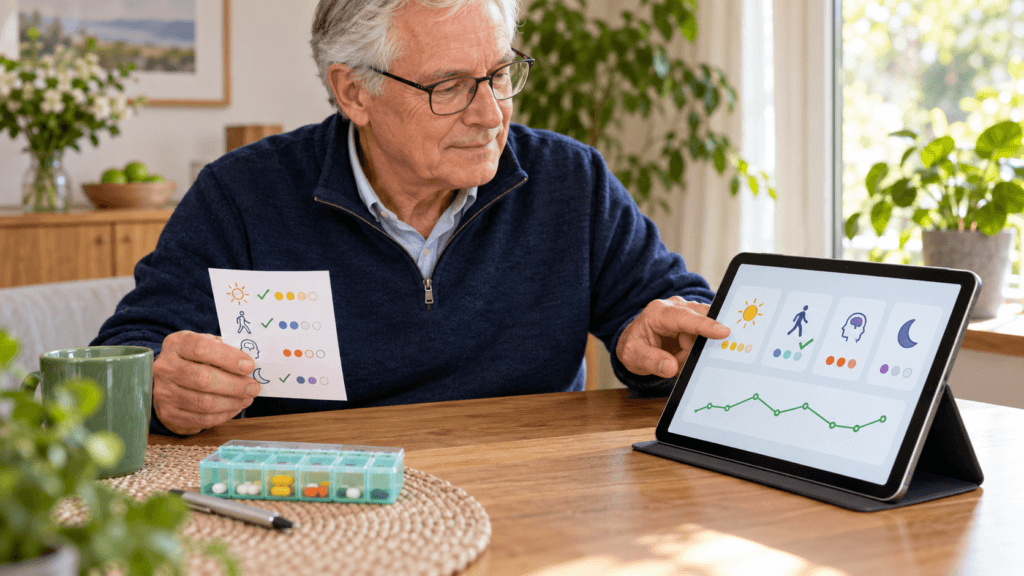
If you record information on paper first, transfer only the most important details into the digital diary. These may include symptom ratings, medication response, ON and OFF periods, falls, side effects, or significant changes.
Avoid creating two complete diaries that contain the same information. Recording everything twice may become tiring and increase the chance that the two records will not match.
A hybrid approach should make tracking easier—not create additional work. Decide which method will be your main record and use the second only when it offers a practical advantage.
Key takeaway: Paper and digital tools can be used together, but keep one as your main diary to avoid unnecessary duplication and confusion.
Try digital tracking with Parkinson’s daily diary
If you want to try digital tracking, the free Parkinson’s Daily Diary app provides a simple daily check-in designed for people living with Parkinson’s.
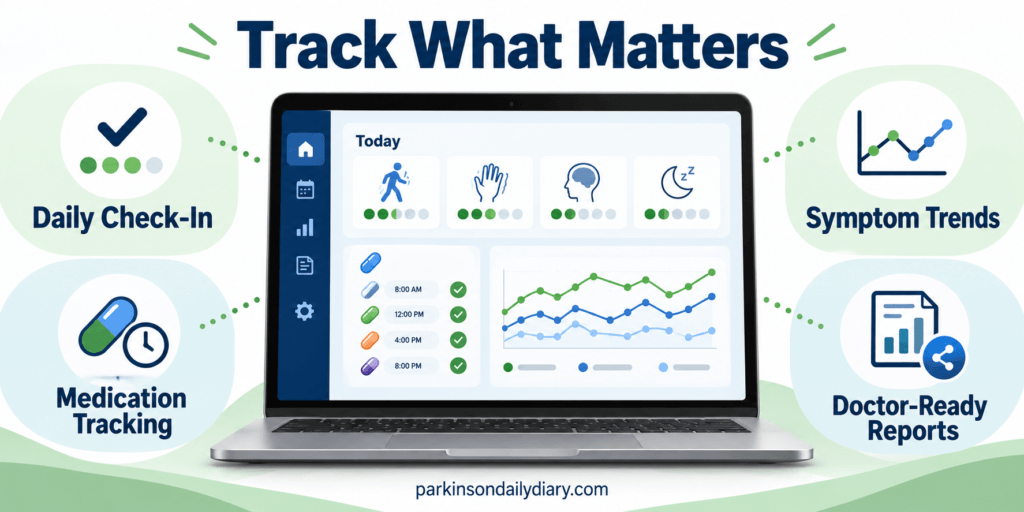
You can use it to record:
- Movement and non-movement symptoms
- Medication timing and response
- ON and OFF periods
- Pain and fatigue
- Daily notes and appointment questions
Your entries are organized into charts and a doctor-ready PDF report. This can make it easier to review changes over time and prepare information for your next appointment. The app works on phones and computers, and caregiver access is also available with the patient’s permission.
You do not need to stop using paper immediately. You can test the app alongside your current diary and decide which method feels easier and more useful.
Start using Parkinson’s Daily Diary for free
Whether you choose paper, digital tracking, or a combination of both, keep the process simple. Focus on the information that matters to you and your healthcare team, and choose a method you can continue using consistently.
The diary is a personal record-keeping tool. It does not provide medical advice, diagnosis, treatment recommendations, or emergency monitoring.
Key takeaway: The best Parkinson’s diary is the one that helps you record meaningful information consistently and communicate it clearly during healthcare appointments.
Disclaimer: This article is for general educational purposes only and does not provide medical advice, diagnosis, or treatment. A Parkinson’s diary should support — not replace — discussions with a qualified healthcare professional. Always consult your healthcare team about symptoms, medication concerns, or changes in your condition. Do not use a paper or digital diary to request emergency assistance.